How Many Roads Must a Man Walk Down?
On Friday, 11th May 2001, Douglas Adams, author of The Hitchhiker’s Guide to the Galaxy, Dirk Gently’s Holistic Detective Agency, Last Chance to See and The Meaning of Liff, died of a heart attack in Santa Barbara, California, aged 49.
I grew up with Hitchhiker’s. Read all the books multiple times, listened to the radio series on cassette, watched the endless reruns of the TV series on UK Gold when we got cable TV in the early 90s.
This post isn’t about Adams.
You are standing at the end of a road
On Saturday the 12th, on ifMUD, Gunther Schmidl announced the DNA Tribute SpeedIF. And then on Sunday morning UK time, posted it to the rec.arts.int-fiction newsgroup, which is where I saw it:
From: "Gunther Schmidl" <gschmidl@gmx.at>
Newsgroups: rec.arts.int-fiction
Subject: [ANN] Douglas Adams Tribute SpeedIF
Date: Sun, 13 May 2001 09:32:11 +0100

In case anyone wants to partake in the Douglas Adams Tribute SpeedIF, this
is how it works:

You have until midnight EST today (Sunday, May 13, 2001). Take any
consecutive two-hour block and write a tribute to Douglas Adams in any IF
programming language you want. E-mail me with a download location or the
file itself when you're done.

If you take a little longer than 2 hours, no problem.
If you take a little longer than midnight EST, I won't be awake to notice.

-- Gunther
For the uninitiated, “interactive fiction” (IF) is the posh name for what we used to call “text adventures”, like ADVENT, Zork and, indeed, The Hitchhiker’s Guide to the Galaxy by Steve Meretzky of Infocom and Douglas Adams himself.
“SpeedIF” was, loosely, a semi-regular two hour contest to write a text adventure from start to finish on a specific, typically rather silly, theme. Any competition was strictly friendly, and the rules were rarely enforced to any great extent.
Writing a game in two hours was (and remains) possible due to the availability of dedicated, free IF tools with excellent standard libraries, such as Graham Nelson’s Inform. All the infrastructure and world rules are provided, you only need to code the locations, objects, and logic unique to the story you want to tell.
Twisty little passages
In 2000/01, I was working my internship year at Zurich Financial Services, living alone for the first time in my life in a strange flat, in a weird building in Cheltenham.
I think it had once been the backstage area of a theatre or something. All the walls were bright golden yellow, except the navy blue bedroom with built-in wardrobe doors painted a garish, gloss industrial orange. I don’t think there was a single straight line or right angle in the building. The hall curved so severely and unexpectedly, I would invariably bounce off the wall on the way to the bathroom or kitchen in the middle of the night.
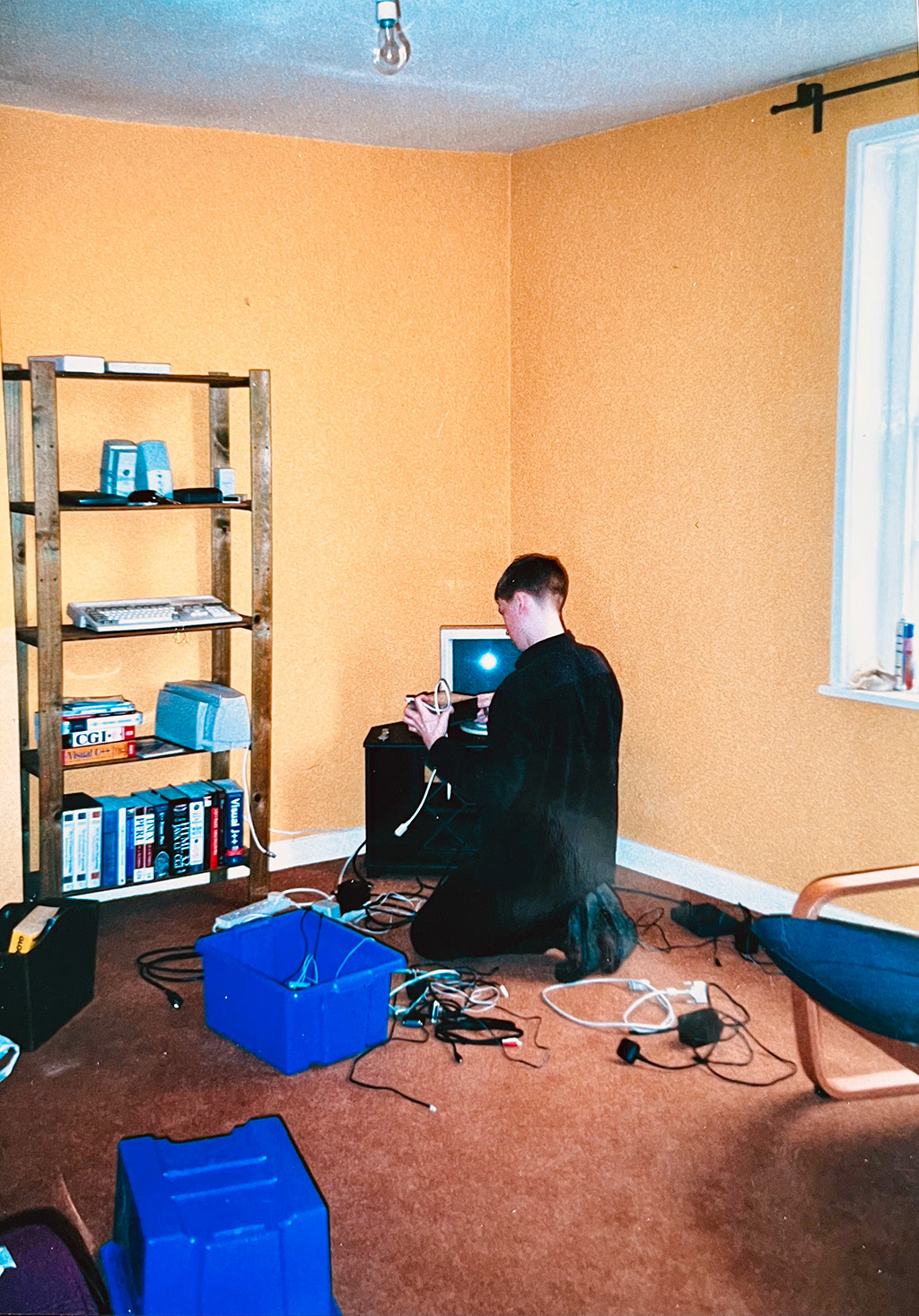
A tiny child moving into a Cheltenham flat in September 2000, laser-focused on the priorities.
I still keep cables in one of those blue storage boxes, and that copy of The Art of Computer Programming is still on my shelf, joined by the first two parts of Combinatorial Algorithms – the glossy dust cover on Volume 4B is repulsive.
Sadly the Amiga A1200, CRT, 56k modem and dual-speed CD-ROM drive were all lost along the way.
Between a Payroll cock-up and me having no clue whatsoever about tax codes, I was paying about three times as much tax as I should have been, on an already low salary.
After rent, food, utilities, and getting my only suit dry-cleaned, I’d have maybe £10-20 left at the end of the month. Usually enough to buy a novel, typically a fantasy doorstop from Steven Erikson, Robin Hobb, or the collected works of one of the old greats like Vance or Zelazny. Or a blister of miniatures from the local Games Workshop – Iyanden Ghost Warriors for 3rd edition Warhammer 40,000 that year: the time and effort required to paint a 40 point, metal Eldar Wraithguard bright yellow offering surprisingly good bang for buck. I also worked my way through all 11 Calvin and Hobbes collections.
So my first year away from home, I was poor as a church mouse, rarely socialised, and spent most evenings and weekends reading, painting, and programming alone in my absurd flat.
Admittedly, a quarter of a century on, that remains pretty much my idea of a good time anyway.

A starving waif, presumably in colder months, with the power of Workbench 3.1, a 50MHz 68030, 2+4MB of RAM and a 120MB IDE hard drive at his fingertips.
For my final year, I finally succumbed and spent my tax refund on a PC, dual booting Win98SE and SuSE Linux, so this was really the end of an era. But that Amiga is the computer I used to teach myself C, Perl, Vim, 68k assembly, HTML, JavaScript, of course Inform… the list goes on. Not a bad run for a machine designed as a budget stopgap, bought in 1992.
I doubt that setup would pass a DSE assessment though.
You can tell this photo was taken before May 2001 because the keycaps don’t have Dvorak legends written on the front in black felt tip.
In the beginning the Universe was created
With the typical first-timer’s grandiose vision of writing an Infocom/Level 9 sized adventure, Inform 6 was one of the things I taught myself that year. I loved text adventures as a kid, growing up with The Hobbit from Melbourne House and Level 9 Computing’s wonderfully atmospheric games like Red Moon, The Worm in Paradise and their version of ADVENT, Colossal Adventure on the Oric Atmos and MSX (a Toshiba HX-10 in my case – these computers probably give you some idea of my dad’s ability to pick a winner when it comes to technology).
Graham Nelson’s superb Inform Designer’s Manual, then in its third edition, provided a comprehensive grounding in not just the how but also the why of crafting text adventures.
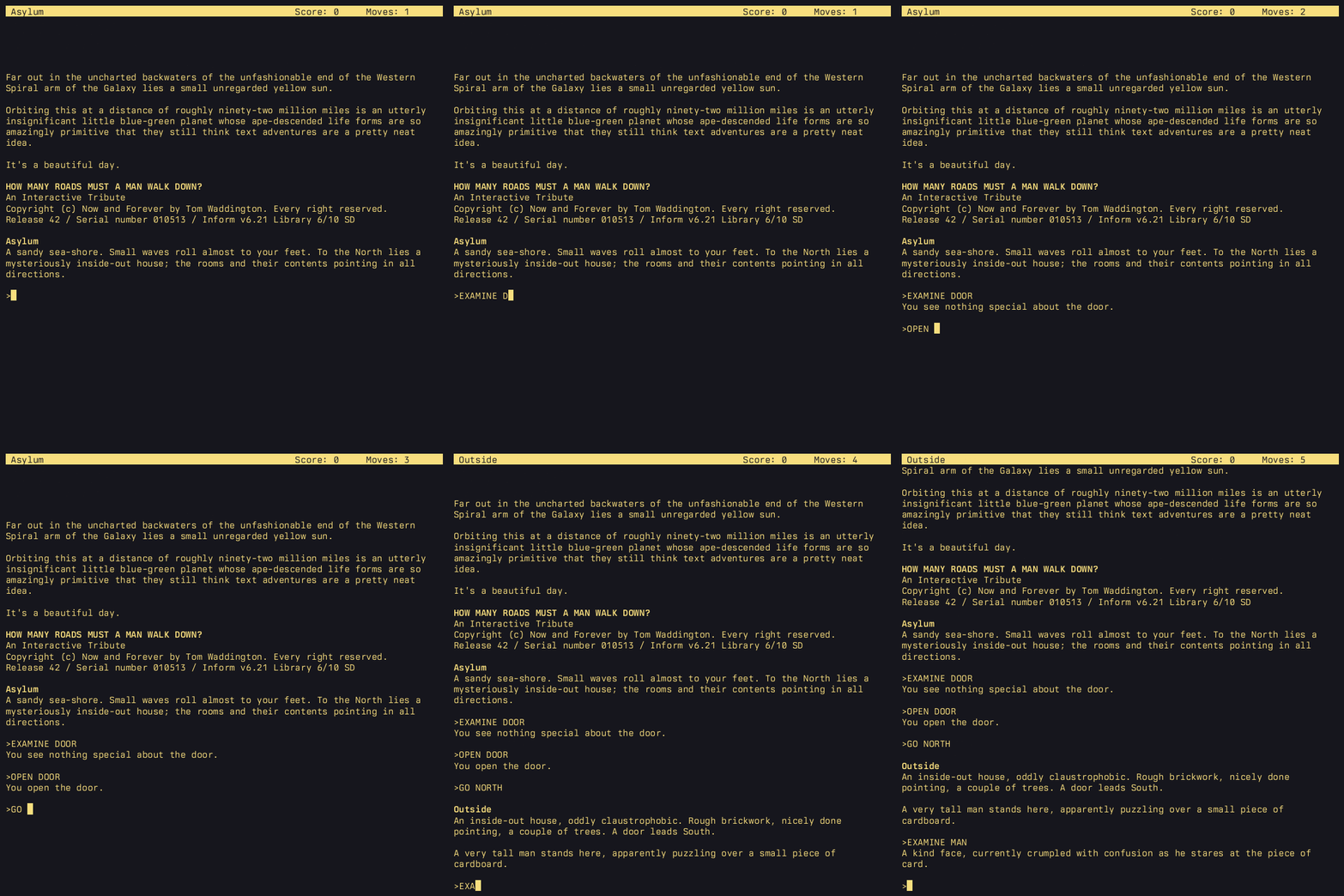
Predictably, I never finished any of the big ideas I’d once had. How Many Roads Must a Man Walk Down? is my only completed game.
I’ve always had a soft spot for So Long, and Thanks for All the Fish. I’ve always found the, oft-criticised, “abrupt authorial intrusions” funny and, outside those pages, it felt to me like Adams is having more fun writing a sweet, gentle romance than he’d had with some of the wackier sci-fi adventures of the original trilogy. Even though, famously, he in fact wasn’t. At all.
My copy of the novel was back home in Sheffield that day, so I ventured into the town centre to track down a new one. Consulting historical weather records online, it seems it only hit 25°C on that sunny day in Cheltenham. Maybe it was negotiating the crowds, but I was absolutely dripping with sweat by the time I made it home.
As I recall, I rattled off the entire development in a single session just shy of the two hour limit.
At the time, I don’t remember seeing much reaction by anyone to any of the entries, although I think Gunther told me it was “a lovely tribute” when I submitted it. And two and a half decades later, I find myself cringing at some of my 21 year old self’s insufferable prose. To me now, any good bits are obvious and minor riffs on Adams’ original text.
But I discovered today that, 20+ years later, Andrew Schultz in Chicago wrote a very sweet review. Just occasionally, the internet can still be as magical a technology as Douglas believed it to be.
But this post isn’t about my daft little game either. Not really.
I may not have gone where I intended to go
I’ve been thinking a lot lately about meaningful work. For better or worse, I’ve spent the last 7-8 years of my career working on one neverending death march of a project after another. They’ve been critically important to their respective organisations, and in many ways satisfying to deliver. But in each case, the process has passed in a numb blur.
There’s definitely something about short, sharp periods of creative activity that engenders equally intense memories of everything surrounding them. I have similarly vivid reminiscences of the weekend I was inspired to rewrite an ecommerce frontend in XHTML, of an evening kit-bashing a Space Marine Librarian, of a mad 36 hour straight crunch responding to a change in COVID-19 testing regulations.
These aren’t all the most impactful projects I’ve ever worked on by any means (though some were). Sometimes they were incredibly stressful experiences.
It already feels clichéd to state it aloud but, in particular, I can’t imagine ever having this experience from that day I wrote a really fantastic LLM prompt. What they share are clear boundaries. A beginning, a middle, and something to point at when I’m done. We obviously can’t abandon the long marches entirely, but I hope to be more deliberate about breaking them up. To insist on carving out more afternoons like that Sunday in Cheltenham, rather than sleepwalking through months and years waiting for the next one to happen by accident.
Anyway.
I suspect I still have the original source code backed up somewhere, but most likely in the depths of some long-forgotten S3 bucket. If you’d like to play my old game though, you can download it here. You’ll need a Z-code interpreter, they’re freely available for almost every device under the sun.